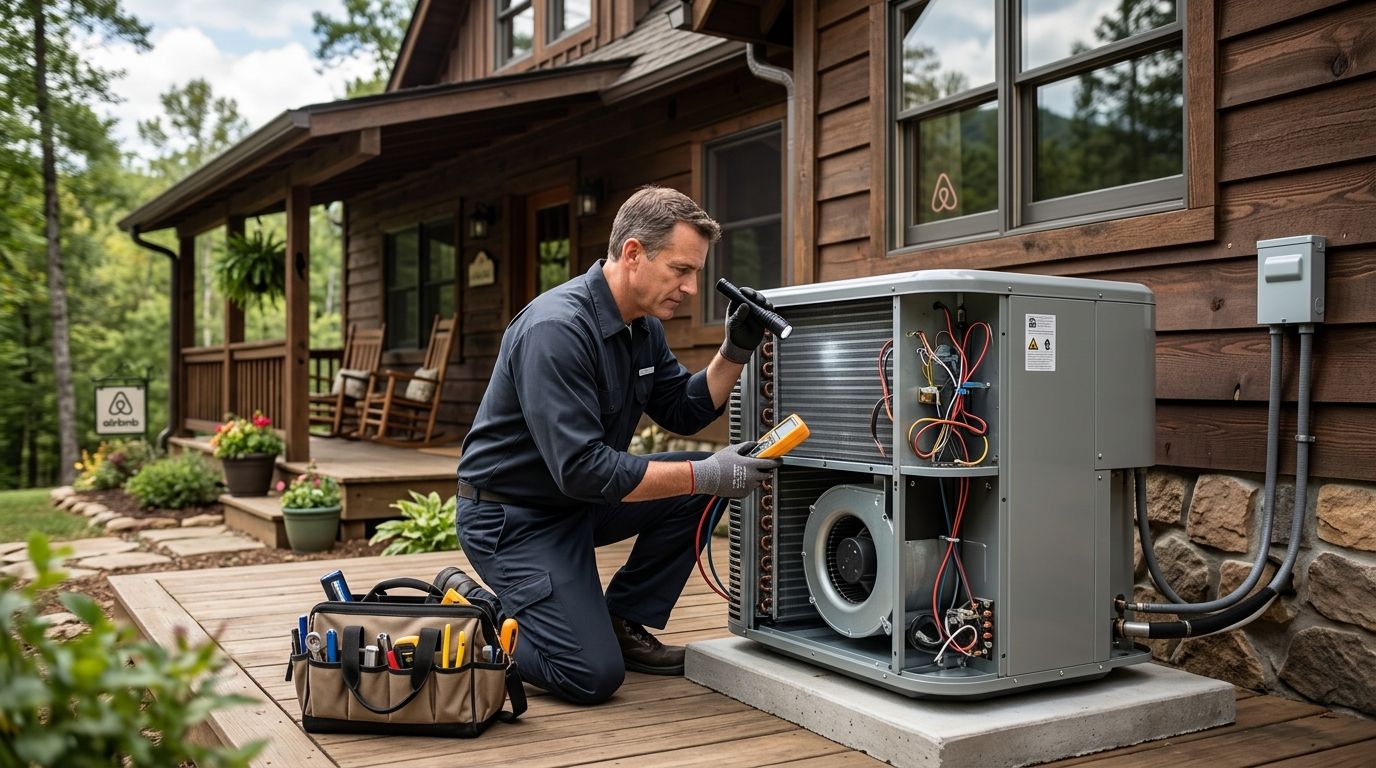
Short-term rental HVAC maintenance is a scheduled upkeep routine built around guest turnover instead of family occupancy, with the aim of protecting booking reviews and rental income rather than just comfort. A host managing a Lake of the Ozarks cabin or condo can't wait for a system to "act up" the way an owner-occupant might — a guest who shows up to a 90-degree living room in July leaves a one-star review before you even get a text.
- HVAC maintenance for Airbnb hosts means turnover-based filter checks, seasonal tune-ups timed to booking gaps, and remote monitoring — not annual service.
- West Heating & Cooling books pre-season tune-ups for Lake of the Ozarks rental owners ahead of the May-through-September peak.
- A smart thermostat with remote access catches a failing system before a guest does, often days before check-in.
- Skipping maintenance between guests is the single most common mistake short-term rental hosts make with their HVAC systems.
Why HVAC maintenance matters more for Airbnb hosts
A guest doesn't call a technician when the AC struggles — they leave, request a refund, and post about it. There's no one living in the unit to notice a slow leak, a dirty filter, or a thermostat set wrong by the last renter, so small problems compound between cleanings instead of getting caught early.
The Lake of the Ozarks rental market runs on tight turnover windows, often same-day checkout to check-in, which leaves little room for a technician visit if something fails mid-season. Hosts who treat HVAC maintenance the way they'd treat a lake house HVAC system — built for seasonal occupancy swings and humidity from lakefront exposure — avoid most of the emergency calls that eat into a summer's profit.
West Heating & Cooling's take: a rental unit that skips one season of HVAC maintenance is the rental unit generating the next bad review. That's not a guess — it's the pattern behind most emergency service calls at properties with no regular upkeep on file.
Build your maintenance routine in six steps
Set a turnover-based filter change schedule
A family changes a filter every one to three months. A short-term rental with back-to-back guests, pets, and lake dust needs it checked far more often.
- Check the filter at every cleaning turnover, not on a calendar
- Stock a season's worth of filters on-site so cleaners can swap without a special trip
- Use a filter with a MERV rating high enough for guests with allergies, without choking airflow on an older blower
- Log the change date on the filter housing so cleaners and hosts stay in sync
- Flag units running constant AC in summer for more frequent swaps
Schedule professional tune-ups around your booking calendar
DIY filter swaps catch the obvious problems. They don't catch a refrigerant leak, a cracked heat exchanger, or a capacitor about to fail — those need a technician, and they need to happen before your busy season, not during it.
- Book a spring tune-up before Memorial Day weekend bookings start
- Book a fall tune-up before the first cold snap and holiday rental demand
- Ask about a maintenance plan built for the property rather than one-off visits, since a plan locks in priority scheduling during peak season
- Request a written service report you can keep for guest disputes or insurance
- Avoid scheduling tune-ups during a confirmed booking window — build in a buffer day
Install a smart thermostat you can monitor remotely
A host who lives an hour from the property, or out of state entirely, can't feel that the house is running warm. A connected thermostat closes that gap.
- Set remote alerts for temperature swings outside a normal range
- Use geofencing or scheduled setbacks between guest stays to cut energy waste
- Compare options built for rental use in the guide to smart thermostats for HVAC systems before picking one for a vacation property
- Give cleaning staff simple, guest-proof access so they can adjust settings without a lockout code
- Pull usage history monthly to spot a system running longer than it should
Size the system for guest turnover, not owner habits
A unit sized for one family living there most of the year behaves differently once eight guests a month are cycling through, opening doors, running the AC at 65 in August, and leaving windows cracked.
- Check that tonnage matches square footage and lake-house humidity load, not just a generic rule of thumb
- Flag rooms that run consistently hotter or colder during full-occupancy stays
- Consider a ductless mini-split for a bunk room or converted space that runs hot only when guests are in it
- Ask a technician to check duct balance if certain rooms get repeat guest complaints
Build an emergency response plan for mid-stay breakdowns
A breakdown at 9 p.m. on a Saturday with a full house of guests is not a problem you can solve yourself. You need a contractor who answers, and a plan for what happens before they arrive.
- Keep a 24/7 emergency service number saved in your property management system, not just your phone
- Give a cleaner or local co-host authority to let a technician in without waiting on you
- Stock a backup fan or portable unit for a short gap between the call and the fix
- Draft a guest message template for a refund or partial credit if service can't happen same-day
Document maintenance for reviews, insurance, and platform requirements
A guest complaint about the AC turns into a platform dispute faster when you have no record of upkeep. A paper trail protects you.
- Keep every service invoice and tune-up report in one folder, digital or physical
- Note the date of the last filter change in your property management notes
- Attach maintenance records to any insurance claim involving HVAC damage or failure
- Reference your maintenance schedule in guest communication if a booking platform asks for proof of habitability standards
Get your rental on a maintenance schedule
West Heating & Cooling services short-term rentals across Camdenton, Osage Beach, and Lake Ozark.
Comparing maintenance approaches for rental hosts
| Option | Best for | Key limitation |
|---|---|---|
| DIY filter changes only | Hosts self-managing one small unit | Misses refrigerant, electrical, and mechanical issues entirely |
| One-off tune-up visits | Hosts who want inspections without a contract | No priority scheduling during peak booking season |
| HVAC maintenance plan | Multi-property hosts and full-time rental operators | Requires committing to a recurring service relationship |
| Smart thermostat monitoring alone | Remote hosts wanting early warning of problems | Detects symptoms, not the underlying mechanical cause |
Verdict: a maintenance plan paired with a smart thermostat gives a remote host both the early warning and the scheduled fix — DIY filter changes alone are not enough for a property running guest turnover year-round.
“A rental unit that skips one season of HVAC maintenance is the rental unit generating the next bad review.”
Common mistakes Airbnb hosts make with HVAC
- Waiting for a guest complaint to call a technician. By the time a guest reports it, the system has likely been struggling for days.
- Skipping maintenance in the off-season. A unit that sits idle for months without a check often fails the moment full-season demand hits it again.
- Letting cleaners guess at thermostat settings. Inconsistent setbacks between guests waste energy and stress the system with constant temperature swings.
- Treating a lake-house unit like a standard home system. Humidity and seasonal exposure near the water add wear that a generic maintenance schedule doesn't account for.
- Not budgeting maintenance into the nightly rate. Hosts who treat HVAC upkeep as an unplanned expense are the ones most likely to defer it until something breaks.
FAQ
How often should an Airbnb host schedule HVAC maintenance?
Most short-term rentals need two professional tune-ups a year, one before spring cooling season and one before fall heating season, plus filter checks at every guest turnover. High-occupancy properties in 2026 running back-to-back summer bookings often need a mid-season filter check as well.
Is HVAC maintenance for Airbnb hosts different from a regular home?
Yes. A regular home has one household setting habits; a rental cycles through different guests, temperature preferences, and occupancy levels every few days, which puts more load on the system and filter than a typical family home.
What's the best way to monitor HVAC remotely at a rental property?
A smart thermostat with remote alerts is the most direct option, letting a host or manager see temperature swings and system runtime without being on-site. It won't replace a professional inspection, but it catches problems early.
Should I get a maintenance plan or pay per visit for a rental unit?
A maintenance plan makes more sense for hosts managing multiple properties or units with heavy year-round booking, since it locks in scheduling before peak season fills a contractor's calendar. A single low-occupancy property can sometimes get by on scheduled one-off visits.
What happens if the AC breaks during a guest's stay?
Without a 24/7 emergency service contact on file, most hosts scramble to find same-day help, which often means paying premium rates or refunding the guest. Keeping an emergency number saved in advance cuts the response gap significantly.
Does HVAC maintenance affect Airbnb reviews?
Directly. Temperature complaints are one of the most common review-lowering issues on short-term rental platforms, and most stem from a system that hadn't been serviced before the guest's stay.
Can a smart thermostat replace professional HVAC maintenance?
No. It flags symptoms like unusual runtime or temperature drift, but it can't diagnose a refrigerant leak, worn capacitor, or blower motor issue the way a technician's inspection can.
How much does neglecting HVAC maintenance cost a rental host?
The direct cost is an emergency repair bill, usually higher than a scheduled visit. The indirect cost is lost future bookings from a lowered review score, which often outweighs the repair itself.
One last thing
The detail most hosts miss: the property manager or cleaner walking through between guests is your earliest warning system, not the guest. A five-minute filter check and thermostat glance at every turnover catches more problems before check-in than any smart device alert, and it costs nothing but a habit change.