Picking the right air conditioner size for a Missouri home comes down to square footage, humidity load, and how the house is built — not just the tonnage a neighbor bought. This guide ranks the common residential AC sizes by home type so you can match tonnage to your square footage before you call anyone for a quote.
- Best overall for a typical Lake of the Ozarks home (1,600-1,900 sq ft): a 3-ton air conditioner.
- Best air conditioner size for small cabins under 900 sq ft: 1.5-ton.
- Best for large walkout lake homes over 2,600 sq ft: 4-ton to 5-ton.
- Oversized units short-cycle and leave humidity behind — bigger is not automatically better in Missouri summers.
- A Manual J load calculation beats any square-footage rule of thumb, including this one.
Why this matters
An air conditioner that's too small runs constantly and never quite catches up on the hottest Missouri afternoons. One that's too big cools the air fast, shuts off, and never runs long enough to pull humidity out of the house — you end up with a cold, clammy living room in July 2026.
Around Camdenton, Osage Beach, Lake Ozark, Warsaw, and Lebanon, humidity off the lake makes this worse than in a dry climate. Getting the size right matters more here than in most of the country, and it's the single biggest factor in whether a new system actually feels comfortable.
The sizing ranges below reflect standard HVAC industry rules of thumb (roughly 20 BTU per square foot as a baseline, adjusted up or down for insulation and window load). They're a starting point for comparison shopping — a proper installation still needs a room-by-room load calculation, not a tape measure and a guess.
What makes the best air conditioner size for a Missouri home
- Total square footage — the baseline number every tonnage chart starts from
- Ceiling height and window count — vaulted ceilings and lake-facing glass add cooling load fast
- Insulation and duct condition — older Missouri homes with leaky ducts need more capacity than newer builds of the same size
- Humidity load — lake proximity pushes homes toward the larger end of a size range, not the smaller end
- Single-story vs. two-story layout — heat rises, so upstairs zones carry more of the burden
- Existing ductwork — homes without ducts (cabins, additions, converted garages) point toward ductless options instead of central tonnage
Air conditioner sizes at a glance
| Size | Best for | Standout feature | Key limitation |
|---|---|---|---|
| 1.5-ton (18,000 BTU) | Cabins and cottages under 900 sq ft | Lowest operating cost of the group | Struggles if the cabin has vaulted ceilings or lots of glass |
| 2-ton (24,000 BTU) | Small ranch homes, 900-1,300 sq ft | Common retrofit size for older Ozarks homes | Undersized for open floor plans in that range |
| 2.5-ton (30,000 BTU) | Mid-size single-story homes, 1,300-1,600 sq ft | Balances upfront cost against runtime | Borderline for homes with finished basements added later |
| 3-ton (36,000 BTU) | The typical Lake of the Ozarks home, 1,600-1,900 sq ft | Best overall match for regional square footage | Oversized for anything under 1,500 sq ft |
| 4-ton (48,000 BTU) | Larger two-story or walkout lake homes, 2,200-2,600 sq ft | Handles zoned upstairs/downstairs loads | Can short-cycle if the home is closer to 2,000 sq ft |
| 5-ton (60,000 BTU) | Large homes and light commercial spaces, 2,600-3,200+ sq ft | Highest total capacity in the residential range | Needs correctly sized ductwork or it underperforms |
1. 1.5-ton AC: best for lake cabins and cottages under 900 sq ft
A 1.5-ton system (18,000 BTU) fits small, single-story cabins and cottages common around the lake — the kind of footprint where a bigger unit would cycle on and off before it ever pulls humidity out of the air.
1.5-ton pros:
- Lowest electricity draw of any size on this list
- Matches the compact footprint of most lake cabins
- Cheaper to service and replace long-term
1.5-ton cons:
- Falls short fast if the cabin has a vaulted great room or wall-to-wall lake-facing windows
- Not a fit for additions or converted porches without a separate load check
Best for: cabins and cottages, single story, under 900 sq ft. Verdict: Buy if the footprint and window count match — don't upsize just because a bigger number sounds safer.
2. 2-ton AC: best for small ranch homes, 900-1,300 sq ft
The 2-ton system (24,000 BTU) is the workhorse size for older, single-story ranch homes scattered through Camdenton and Warsaw — small enough to avoid short-cycling, large enough to handle a normal Missouri summer.
Homes without existing ductwork in this size range are often a better match for a ductless mini-split system than a central 2-ton unit, especially additions and detached spaces.
2-ton pros:
- Common, well-supported size with wide equipment availability
- Handles most single-story homes without oversizing
- Reasonable install cost relative to larger tonnage
2-ton cons:
- Open floor plans near the top of this range can feel undersized on 95-degree days
- Doesn't cover finished basements or bonus rooms on its own
Best for: single-story ranch homes, 900-1,300 sq ft. Verdict: Buy for straightforward single-story layouts in this range.
3. 2.5-ton AC: best for mid-size single-story homes, 1,300-1,600 sq ft
The 2.5-ton size (30,000 BTU) sits between the most common small-home and mid-home tiers, and it's frequently the right call for homes that grew with an addition after the original build.
2.5-ton pros:
- Covers the gap between 2-ton and 3-ton without overshooting
- Good fit for homes with one added room or finished porch
- Solid humidity control for moderate square footage
2.5-ton cons:
- Borderline undersized if the home has a finished basement added later
- Less common than 2-ton or 3-ton, so fewer equipment options
Best for: single-story homes with a minor addition, 1,300-1,600 sq ft. Verdict: Hold — get a load calculation before locking this size in if the home has been modified since it was built.
4. 3-ton AC: best overall for the typical Lake of the Ozarks home
The 3-ton system (36,000 BTU) is the best overall air conditioner size for most Missouri homes in this region, matching the 1,600-1,900 square foot range that describes a large share of houses in Camdenton, Osage Beach, and Lake Ozark.
Matching tonnage to square footage only solves half the problem — the brand and efficiency tier behind that tonnage matter just as much for long-term operating cost. That's a separate comparison covered in the best air conditioner brands for Missouri homes breakdown.
3-ton pros:
- Matches the most common home footprint in the region
- Enough capacity for normal window counts and one-story or split-level layouts
- Wide selection across efficiency tiers and brands
3-ton cons:
- Oversized for anything under roughly 1,500 sq ft — expect short-cycling and humid air
- Undersized for two-story homes with a finished basement in the same square footage
Best for: the typical single-story or split-level Lake of the Ozarks home, 1,600-1,900 sq ft. Verdict: Buy — this is the default starting point for a load calculation on a standard regional home.
5. 4-ton AC: best for larger two-story and walkout lake homes
The 4-ton system (48,000 BTU) fits larger two-story homes and walkout lake properties where the upstairs and the finished lower level both need to be covered, whether by one larger system or a zoned setup.
4-ton pros:
- Enough capacity for two-story homes with a finished basement
- Handles the added window load common in lake-view homes
- Works well paired with zoning for upstairs/downstairs comfort differences
4-ton cons:
- Oversized and prone to short-cycling if the actual footprint is closer to 2,000 sq ft
- Higher equipment and duct-sizing requirements than smaller tonnage
Best for: two-story or walkout homes, 2,200-2,600 sq ft. Verdict: Buy for homes solidly in this square footage range; Skip if you're rounding up from 2,000 sq ft.
6. 5-ton AC: best for large homes and light commercial spaces
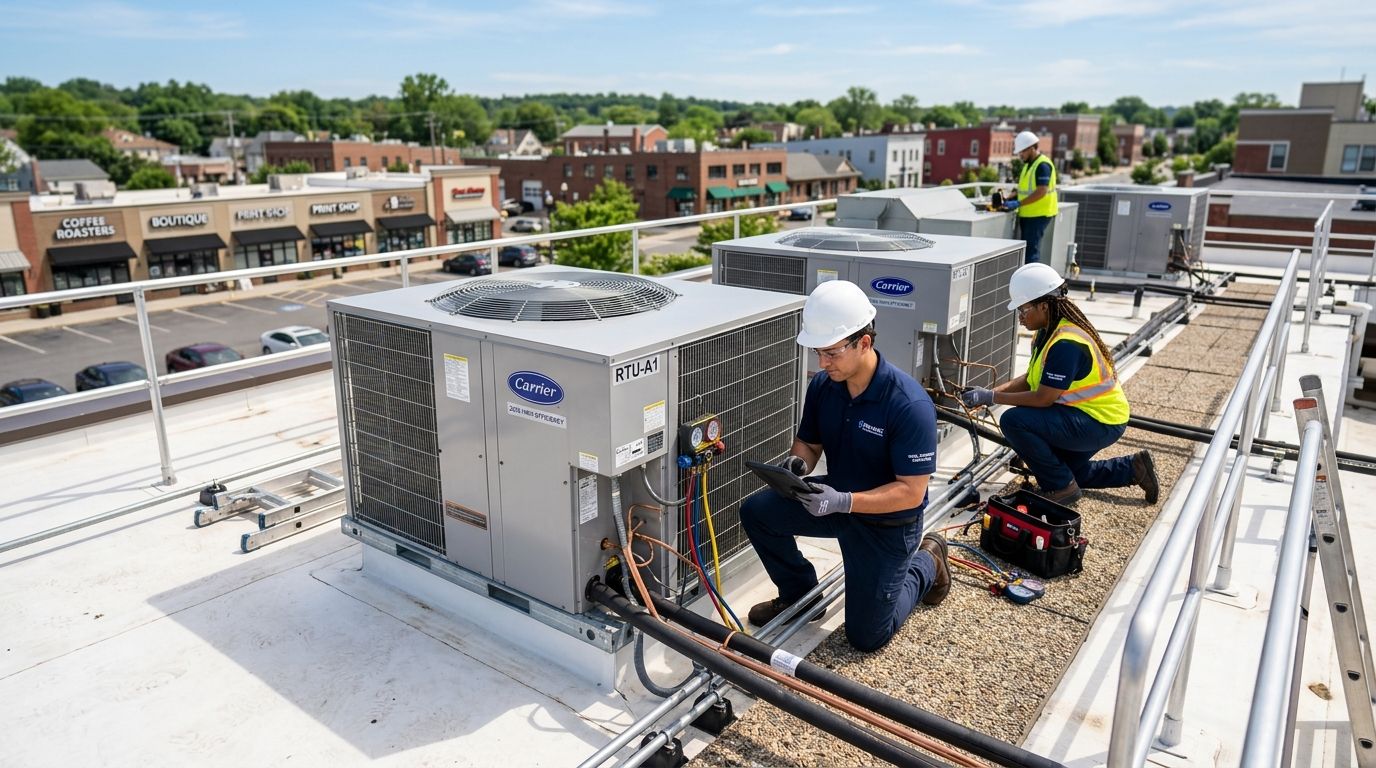
The 5-ton system (60,000 BTU) is the largest common residential size and the right call for large homes over 2,600 square feet, plus small commercial spaces that need central cooling rather than multiple standalone units.
5-ton pros:
- Highest total capacity available in standard residential equipment
- Covers large open floor plans and high ceiling counts
- Suited to properties that mix living space with a home office or workshop
5-ton cons:
- Needs correctly sized ductwork or the extra capacity goes to waste
- Overkill, and expensive to run, for anything under 2,400 sq ft
Best for: large homes and light commercial properties, 2,600-3,200+ sq ft. Verdict: Hold — confirm ductwork capacity before installing a 5-ton system in an existing home.
How this ranking works
Each tier maps to the square footage range where that tonnage runs long enough to dehumidify without short-cycling, based on the standard BTU-per-square-foot guidance HVAC contractors use as a starting point. Ceiling height, window load, and duct condition shift a home up or down within its range — which is exactly why a tape measure alone doesn't replace a Manual J load calculation.
For a side-by-side look at what different tonnage and efficiency combinations cost to install, the HVAC systems ranked by price comparison lays out the tradeoffs by category.
Get your home's exact AC size
A load calculation beats any square-footage chart — get one from West Heating & Cooling.
Which air conditioner size should you choose?
If you don't know where else to start, match your home's square footage to the ranges above and treat 3-ton as the default for a typical regional single-story home. The best air conditioner size for a Missouri home is the one matched to an actual load calculation, not the biggest number your budget allows — oversizing costs more upfront and leaves the house humid all summer.
FAQ
What size air conditioner do I need for a 2,000 sq ft home in Missouri?
A 2,000 sq ft Missouri home typically needs a 3.5-ton to 4-ton air conditioner, depending on ceiling height, window count, and insulation. A load calculation confirms which end of that range fits your specific house.
Is it better to oversize an air conditioner for extra cooling power?
No. An oversized air conditioner cools the air quickly, shuts off, and never runs long enough to remove humidity, leaving rooms cold but clammy. Correct sizing, not oversizing, is what controls humidity in Missouri summers.
How many square feet does a 2-ton AC cover?
A 2-ton air conditioner (24,000 BTU) typically covers 900 to 1,300 square feet, depending on ceiling height and insulation. Older single-story ranch homes in this range are the most common fit.
Does humidity near the Lake of the Ozarks change AC sizing?
Yes. Homes near the lake carry more humidity load than a dry-climate home of the same square footage, which is why sizing toward the upper end of a given range often performs better locally.
What size air conditioner fits a small lake cabin?
A cabin under 900 square feet typically fits a 1.5-ton air conditioner, assuming a standard single-story layout without large window walls. Vaulted ceilings or heavy glass can push that up to a 2-ton unit.
Do homes without ductwork need a different AC size approach?
Yes. Homes without existing ducts, like additions or converted garages, are usually a better fit for a ductless mini-split system sized by zone rather than a central tonnage rating for the whole house.
Is a 5-ton air conditioner too big for a normal house?
A 5-ton air conditioner is oversized for anything under roughly 2,400 square feet and will short-cycle in a smaller home. It's sized correctly for large homes over 2,600 square feet or light commercial spaces.
How much does home size matter compared to insulation quality?
Square footage sets the baseline, but poor insulation or leaky ductwork can push a home up a full tonnage size compared to a newer, tighter-built home of the same footprint.
One last thing
The counterintuitive part of AC sizing: a bigger unit doesn't mean better cooling. An oversized system finishes its cooling cycle in minutes, shuts off, and skips the slow, steady runtime that actually pulls moisture out of the air — which is exactly the problem homes near the Lake of the Ozarks run into most. Right-sizing, not upsizing, is what keeps a Missouri home comfortable through August 2026.