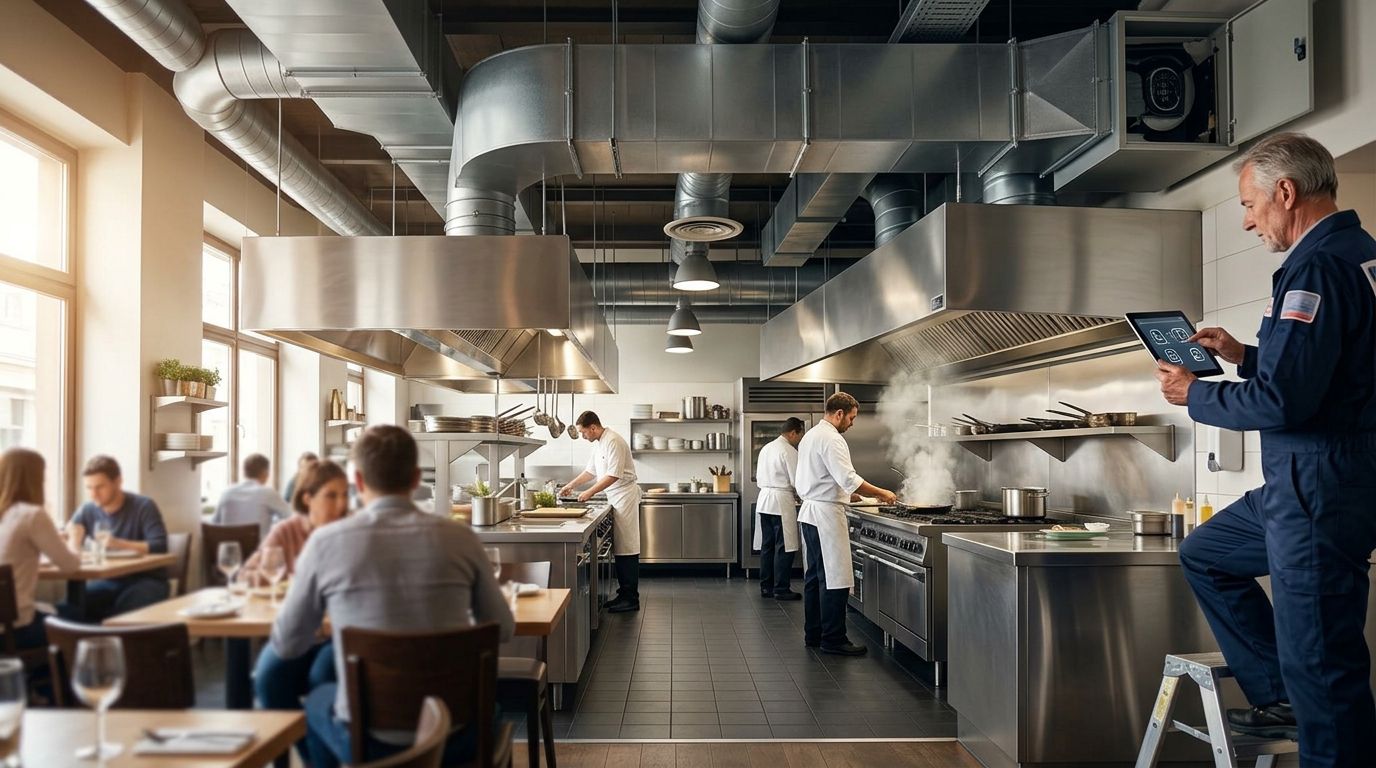
Commercial HVAC for restaurants and commercial kitchens covers the heating, cooling, exhaust, and makeup air equipment sized around grease-laden cooking loads and health-code ventilation rules, not office square footage, with the goal of keeping the line cook comfortable, the dining room at a steady temperature, and the fire marshal satisfied. A restaurant kitchen generates far more heat, grease aerosol, and moisture per square foot than a retail space or office, which means the HVAC design has to start at the hood, not the thermostat.
- Commercial HVAC for restaurants needs separate kitchen and dining zones — one thermostat can't serve both.
- Grease duct and Type I hood cleaning frequency is set by NFPA 96, not by owner convenience.
- Rooftop package units remain the standard commercial HVAC for restaurants in most Missouri kitchens in 2026.
- Undersized makeup air is the leading cause of negative pressure problems — slamming doors, backdraft smells — in commercial kitchens.
- West Heating & Cooling services restaurant and commercial kitchen HVAC across Camdenton, Osage Beach, Lake Ozark, Warsaw, and Lebanon.
Why commercial HVAC for restaurants matters
A restaurant kitchen with a Type I exhaust hood is pulling conditioned air out of the building continuously during service — often at a rate that would empty a small office of its entire air volume in a few minutes. Replace that exhausted air with untreated outside air and you get a kitchen that's freezing in January and swampy in July, no matter how big the rooftop unit is.
That's why commercial HVAC systems for small businesses built for restaurants look different from a standard retail package unit — the exhaust and makeup air load has to be engineered before anyone talks tonnage. Health department inspectors check ventilation and temperature control on every visit; fire marshals check exhaust and duct cleaning records on a fixed schedule. Both show up in the same walkthrough, and both can shut a kitchen down.
Update your hood and makeup air sizing before you touch the HVAC
Most restaurant comfort problems trace back to an exhaust hood and makeup air system that were never matched to the actual cooking equipment underneath.
- Confirm whether each hood is Type I (grease and smoke-producing equipment: fryers, griddles, charbroilers) or Type II (heat and steam only, like dishwashers or steam kettles)
- Calculate exhaust CFM by hood length and cooking duty classification — light, medium, heavy, or extra-heavy — per NFPA 96
- Size makeup air to roughly match exhaust CFM so the kitchen doesn't run under negative pressure
- Keep exhaust ductwork completely separate from comfort cooling ductwork; grease-laden air never runs through the same trunk line
- Get the load calculation done by an HVAC contractor or mechanical engineer, not estimated off square footage alone
Split the kitchen and dining room into separate zones
A kitchen running six burners and two fryers during dinner rush has nothing in common thermally with a dining room seating guests at 72 degrees.
- Put the kitchen on its own thermostat and, ideally, its own dedicated rooftop unit
- Keep dining and bar areas on a second system sized for occupant comfort, not equipment heat
- Plan for higher humidity control in the kitchen zone — cooking and dishwashing add moisture the dining room doesn't produce
- Size pass-through openings and swinging doors to limit air transfer between zones
- Confirm the building automation or thermostat setup lets staff adjust each zone independently during prep, service, and close
Choose a rooftop unit configuration built for kitchen heat
Rooftop package units (RTUs) are still the default choice for standalone restaurants in 2026 because they keep equipment off the kitchen floor and out of the way of staff.
- Confirm the unit is rated for the higher sensible heat ratio typical of kitchen loads, not a generic office sizing chart
- Ask about condenser coil coatings that resist corrosion from grease and grill exhaust — kitchen rooftop units foul faster than retail units
- Place the unit's outdoor air intake away from the hood exhaust discharge point to avoid pulling grease odor back into the building
- Consider an economizer for shoulder-season savings, though Lake of the Ozarks humidity by June limits how much free cooling it delivers
- Match curb height and duct routing to the existing roof penetrations if this is a replacement, not new construction
Build a grease duct and hood cleaning schedule
Cleaning frequency for Type I hoods and grease ducts isn't a maintenance suggestion — NFPA 96 sets it by cooking volume and fuel type, and fire inspectors check the certificate.
- Solid fuel cooking operations: monthly cleaning
- High-volume operations (24-hour service, heavy charbroiling): quarterly cleaning
- Moderate-volume kitchens: semi-annual cleaning
- Low-volume or seasonal kitchens: annual cleaning
- Keep dated cleaning certificates on file for both the fire marshal and your insurance renewal
Add or verify makeup air coverage
A kitchen that can't hold its exterior doors shut in a stiff breeze almost always has an exhaust-to-makeup-air imbalance, not a door problem.
- A dedicated outdoor air system (DOAS) pre-conditions makeup air so staff aren't standing in a cold draft near the hood in January
- Tempered makeup air prevents the pressure differential that causes doors to slam and pilot lights to blow out
- Locate intake louvers away from exhaust discharge points to stop re-entrainment of grease odor
- Verify makeup air dampers open in sync with exhaust fan startup, not on a delay
- Test static pressure annually, not just at initial installation, since duct and filter condition change that number over time
Measure your maintenance cadence against a standard commercial account
Grease-exposed HVAC equipment needs a shorter service interval than the same equipment serving an office or retail space.
- Clean condenser coils more often — grease aerosol from cooking travels farther than most owners expect and fouls coils faster than dust does
- Shorten filter change intervals compared to a standard commercial building
- Check refrigerant charge and compressor amp draw at every visit, since kitchen heat loads run compressors harder
- Inspect belt-drive exhaust fan wheels for grease buildup that throws the fan out of balance
- Compare HVAC maintenance plans built around commercial kitchen schedules rather than a generic residential tune-up
Plan for inspections, permits, and budget before equipment fails
Health department and fire marshal inspections both touch HVAC and exhaust equipment, and a permit is typically required for any hood, duct, or rooftop unit replacement.
- Budget kitchen HVAC replacement as a capital project on a multi-year timeline, not a same-week repair
- Review HVAC systems ranked by price before signing a contract for a rooftop unit or full exhaust retrofit
- Ask what permits and inspections are required in your county before scheduling installation
- Keep documentation for every hood, duct, and rooftop unit change in one file for future inspections
Comparison: HVAC options for restaurants and commercial kitchens
| Option | Best for | Key limitation |
|---|---|---|
| Rooftop package unit (RTU) | Standalone restaurants with roof access | Needs frequent coil cleaning to prevent grease corrosion |
| Split system with dedicated kitchen makeup air | Strip-mall restaurants without roof access | Indoor air handler needs mechanical room space |
| Ductless mini-split zones | Dining room or bar comfort only | Not rated for grease-laden kitchen air — dining-room use only |
| Dedicated outdoor air system (DOAS) | High-volume kitchens needing tempered makeup air | Higher upfront equipment cost than a standard makeup air fan |
Get your kitchen HVAC checked before summer
Free quote for restaurant and commercial kitchen HVAC in the Lake of the Ozarks area.
Common mistakes restaurants make with commercial HVAC
- Undersizing makeup air relative to exhaust CFM — causes negative pressure, slamming doors, and pilot lights blowing out mid-service
- Running kitchen and dining off one thermostat — the dining room runs cold while the kitchen overheats, or the reverse
- Placing rooftop intake too close to the hood exhaust discharge — pulls grease odor and moisture back into the building
- Cleaning condenser coils on a retail schedule — kitchen coils foul faster and need more frequent attention than a standard commercial account
- Skipping duct cleaning records — a missing certificate at inspection can hold up a health department or fire marshal sign-off
FAQ
What size HVAC system does a commercial kitchen need?
Size is set by the exhaust hood's CFM requirement first, then matched with makeup air and comfort cooling — square footage alone is not a reliable sizing method for commercial HVAC for restaurants.
Is commercial HVAC for restaurants different from a standard commercial system?
Yes. Restaurant HVAC has to account for Type I exhaust hoods, grease-laden air, and makeup air balance that a standard office or retail system never sees.
How often should grease ducts be cleaned in a restaurant?
NFPA 96 sets cleaning frequency by cooking volume: monthly for solid fuel operations, quarterly for high-volume kitchens, semi-annual for moderate volume, and annual for low-volume or seasonal kitchens.
Do restaurants need makeup air units?
Any kitchen with a Type I exhaust hood needs makeup air to replace the volume of air being exhausted, or the building runs under negative pressure and doors, dampers, and pilot lights start acting up.
Can a rooftop unit cool a commercial kitchen?
Rooftop package units are the standard choice for restaurant HVAC in 2026, but they need to be sized for kitchen sensible heat loads and paired with dedicated makeup air, not sized like a retail unit.
Should the dining room and kitchen be on separate HVAC zones?
Yes. Kitchen equipment heat and dining room occupant comfort are different loads entirely, and one thermostat can't serve both without one space running uncomfortable.
How long does a commercial kitchen HVAC system last?
Rooftop units serving kitchens see more grease exposure and run harder than standard commercial systems, so coil condition and maintenance history matter more than age alone when deciding on replacement timing.
What causes a restaurant's back door to slam or not stay shut?
That's almost always a negative pressure symptom from exhaust air exceeding makeup air, not a door hardware problem, and it points straight at the kitchen ventilation balance.
One last thing
The fix owners skip most often isn't tonnage — it's makeup air balance. A kitchen where doors won't stay shut, pilot lights blow out, or grease smell drifts into the dining room in 2026 usually needs its exhaust-to-makeup-air ratio checked before anyone recommends a bigger rooftop unit.