Choosing a whole-home dehumidifier in 2026 comes down to how your house is built and how much moisture Lake of the Ozarks summers push into it. Best overall: the Aprilaire 1850, ducted directly into your existing furnace or air handler. Best for crawl spaces and standalone basements: the Santa Fe Classic. Best compact option for smaller homes: the Ultra-Aire 70H.
- Aprilaire 1850 is the best whole home dehumidifier for 2026 if you already have central ductwork - rated at 95 pints per day.
- Santa Fe Classic fits crawl spaces and basements without tying into a duct system, rated at 90 pints per day.
- Honeywell TrueDRY DR120 handles the largest homes at 120 pints per day but draws the most power.
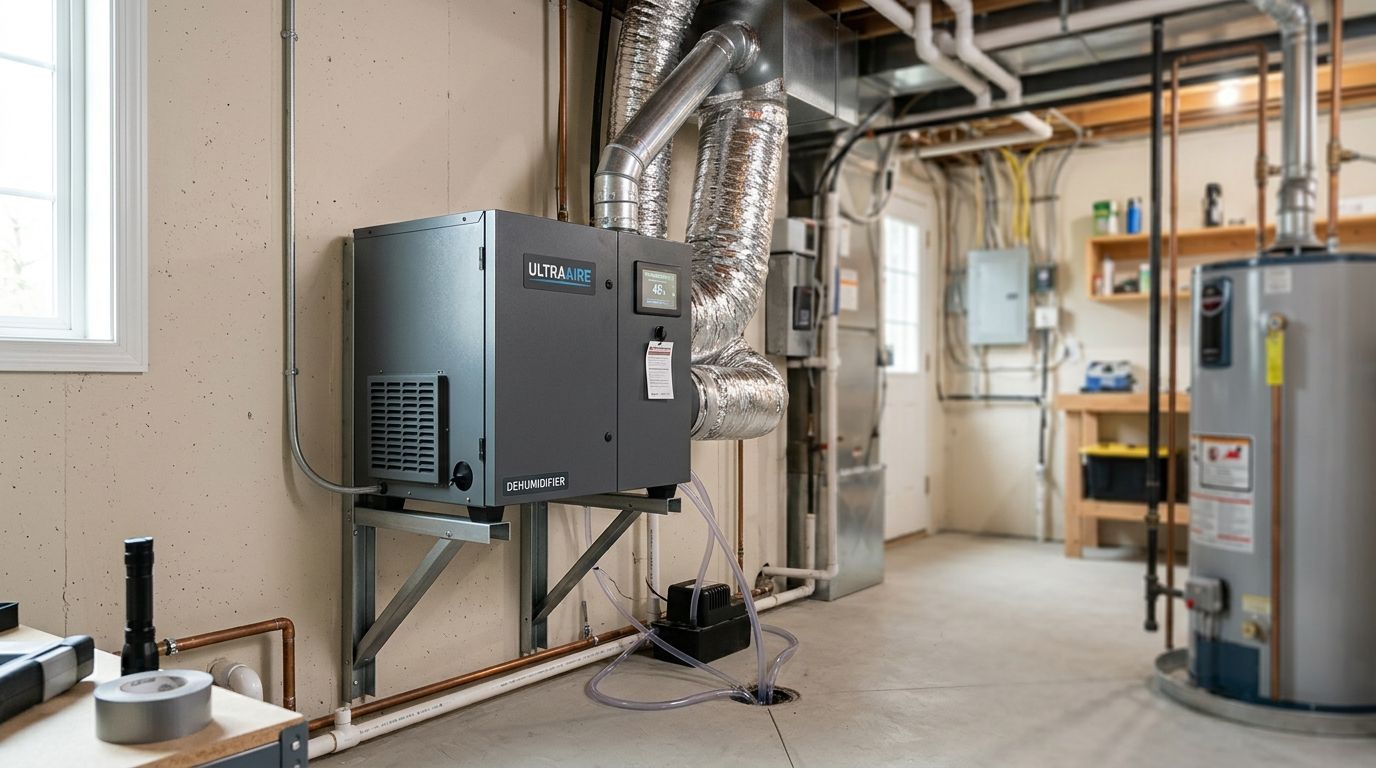
- Ultra-Aire 70H is the compact pick for homes under 2,000 square feet.
- Professional ducted installation matters more than brand name for long-term performance in humid Missouri summers.
Why this matters
Lake of the Ozarks summers push relative humidity well past the 50% mark most HVAC pros consider comfortable, and the U.S. EPA recommends keeping indoor humidity between 30% and 50% to control mold and dust mites. A single portable unit can't keep up with a whole house — it treats one room while the rest of your home stays damp.
A whole-home dehumidifier ties into your ductwork or stands alone in a crawl space, pulling moisture out before it hits your walls, floors, and HVAC coils. If you're already comparing air conditioner brands for Missouri homes, humidity control belongs in that same conversation — a dehumidifier reduces the load on your AC compressor and can extend equipment life. Homeowners near Camdenton, Osage Beach, and Lake Ozark deal with this every July and August, and West Heating & Cooling installs and services these systems across that footprint.
What makes the best whole-home dehumidifier
- Rated capacity — pints of water removed per day under AHAM test conditions
- Ducted vs. standalone — whether it ties into existing HVAC ductwork or runs independently
- Airflow rating (CFM) — how much conditioned air it can move through the system
- Filtration — whether it includes MERV-rated filtration alongside dehumidification
- Noise and placement — how much mechanical room or crawl space clearance it needs
- Compatibility — whether it works with your existing furnace or air handler without major duct rework
Whole-home dehumidifiers at a glance
| Model | Best for | Standout feature | Key limitation |
|---|---|---|---|
| Aprilaire 1850 | Ducted whole-home installs | 95 pints/day, ties into existing ductwork | Needs professional duct integration |
| Santa Fe Classic | Crawl spaces & basements | 90 pints/day, standalone unit | Doesn't distribute to whole house without an added duct kit |
| Honeywell TrueDRY DR120 | Large homes, heavy humidity load | 120 pints/day, highest capacity here | Highest power draw and largest footprint |
| Ultra-Aire 70H | Smaller homes under 2,000 sq ft | Compact ducted design | Lower capacity struggles in peak Ozarks humidity for larger homes |
1. Aprilaire 1850: best whole-home dehumidifier for ducted installation
The Aprilaire 1850 ties directly into your existing furnace or air handler ductwork and treats the entire house from one location. It's rated at 95 pints of moisture removal per day and typically supports MERV 13 filtration alongside the dehumidification function.
Aprilaire 1850 pros:
- Rated at 95 pints/day, enough for most single-family homes in the region
- Integrates with existing ductwork instead of running as a separate appliance
- Optional MERV 13 filtration handles dust alongside humidity
Aprilaire 1850 cons:
- Requires an existing forced-air duct system or new duct runs
- Needs mechanical room clearance for professional install
Best for: homeowners with central HVAC who want one system handling the whole house. Verdict: Buy if you have ductwork already in place.
2. Santa Fe Classic: best for crawl spaces and standalone basements
The Santa Fe Classic doesn't need to tie into your furnace ductwork — it runs as a standalone unit, which makes it the pick for crawl spaces, unfinished basements, or homes without a central duct system reaching every area.
Santa Fe Classic pros:
- Rated at 90 pints/day, close to the Aprilaire 1850's capacity
- No dependency on existing ductwork
- Built for damp, low-clearance spaces like crawl spaces
Santa Fe Classic cons:
- Won't distribute dry air to the whole house without an added duct kit
- Standalone placement means periodic filter and drain-line checks
Best for: basement and crawl space moisture problems separate from your main HVAC system. Verdict: Buy for crawl space and basement-specific humidity issues.
3. Honeywell TrueDRY DR120: best for large homes with heavy humidity load
At 120 pints per day, the Honeywell TrueDRY DR120 has the highest capacity on this list. It's built for larger multi-level homes over roughly 4,000 square feet or houses with unusually heavy moisture loads.
Honeywell TrueDRY DR120 pros:
- Highest rated capacity in this comparison at 120 pints/day
- Handles large or multi-zone homes that overwhelm smaller units
Honeywell TrueDRY DR120 cons:
- Highest power draw of the four
- Larger physical size means it needs more mechanical space
Best for: large homes or properties with persistent, hard-to-control humidity. Verdict: Buy if square footage and humidity load justify the larger capacity — Skip for average-size homes where it's overkill.
4. Ultra-Aire 70H: best compact ducted option for smaller homes
The Ultra-Aire 70H is built for tighter mechanical closets and smaller ductwork runs, rated at 70 pints per day. It fits homes under roughly 2,000 square feet without the footprint of the larger units above.
Ultra-Aire 70H pros:
- Compact footprint fits tighter mechanical spaces
- Ducted design still integrates with existing HVAC
- Lower capacity is enough for smaller, well-sealed homes
Ultra-Aire 70H cons:
- 70 pints/day may not keep up in larger homes during peak Ozarks humidity
- Less headroom for future additions to the home
Best for: smaller homes or ranch-style properties with limited mechanical room space. Verdict: Buy for compact homes, Wait if you're planning a home addition that will need more capacity.
How we ranked these
The ranking above weighs rated capacity, whether the unit ties into existing ductwork or stands alone, and how much mechanical space each install demands — the same four criteria listed earlier. No single unit wins every category, which is why the segment matters more than the raw capacity number.
Get a dehumidifier install quote
Serving Camdenton, Osage Beach, Lake Ozark, Warsaw, and Lebanon.
Which whole-home dehumidifier should you choose?
If you already have central ductwork, the Aprilaire 1850 is the default pick for 2026 — 95 pints/day covers most homes in the region without oversizing. Go with the Santa Fe Classic if the problem is isolated to a crawl space or basement that doesn't share ductwork with the rest of the house. Reserve the Honeywell TrueDRY DR120 for genuinely large homes, and the Ultra-Aire 70H for smaller, tighter mechanical spaces. Whichever unit fits your house, proper sizing and duct integration matter more than brand name — an oversized or undersized unit runs inefficiently no matter what's stamped on the label.
Humidity control ties directly into heating and cooling equipment decisions. If you're weighing a heat pump for a Missouri winter alongside dehumidification, both systems should be sized together rather than bolted on separately after the fact.
FAQ
What's the best whole home dehumidifier in 2026?
The Aprilaire 1850 is the best overall pick for 2026 if you have existing central ductwork, rated at 95 pints of moisture removal per day. For crawl spaces or basements without shared ductwork, the Santa Fe Classic is the better fit.
Is a whole-home dehumidifier better than a portable unit?
Yes, for whole-house humidity problems. A portable unit only treats the room it sits in, while a ducted or standalone whole-home unit removes moisture from the entire structure.
How much humidity should a Missouri home have?
The EPA recommends keeping indoor relative humidity between 30% and 50% to limit mold and dust mite growth. Lake of the Ozarks summers frequently push above that range without mechanical dehumidification.
Can a whole-home dehumidifier tie into my furnace or AC ductwork?
Ducted models like the Aprilaire 1850 and Ultra-Aire 70H connect directly to existing forced-air ductwork. Standalone models like the Santa Fe Classic run independently unless you add a separate duct kit.
How much capacity do I need for a Lake of the Ozarks home?
Most single-family homes in the region are covered by a 90 to 95 pint/day unit like the Santa Fe Classic or Aprilaire 1850. Larger homes over roughly 4,000 square feet or homes with heavy moisture loads may need a 120 pint/day unit like the Honeywell TrueDRY DR120.
Do I need a professional to install a whole-home dehumidifier?
Ducted models require tying into or modifying existing ductwork, which is a job for a licensed HVAC contractor. Standalone crawl space units still need proper drainage and electrical hookup done correctly.
How often does a whole-home dehumidifier need maintenance?
Filters need periodic cleaning or replacement and drain lines need checking to prevent clogs, similar to furnace and AC maintenance schedules. Skipping maintenance reduces rated capacity over time.
Does a whole-home dehumidifier replace my AC?
No. It works alongside your AC and furnace, reducing the moisture load your cooling system has to handle rather than replacing heating or cooling equipment.
One last thing
Oversizing is the most common mistake homeowners make when shopping in 2026 — a 120 pint/day unit in a 1,800 square foot home short-cycles constantly and wastes energy, while an undersized unit in a large home never catches up during peak Ozarks humidity in July and August. Match the rated capacity to your actual square footage and existing ductwork before you match it to a brand name.